The Crack Team is not the only covert organization in the world, and it would be folly to think we could not learn from others. Agents are encouraged to read this spy manual to learn new techniques.
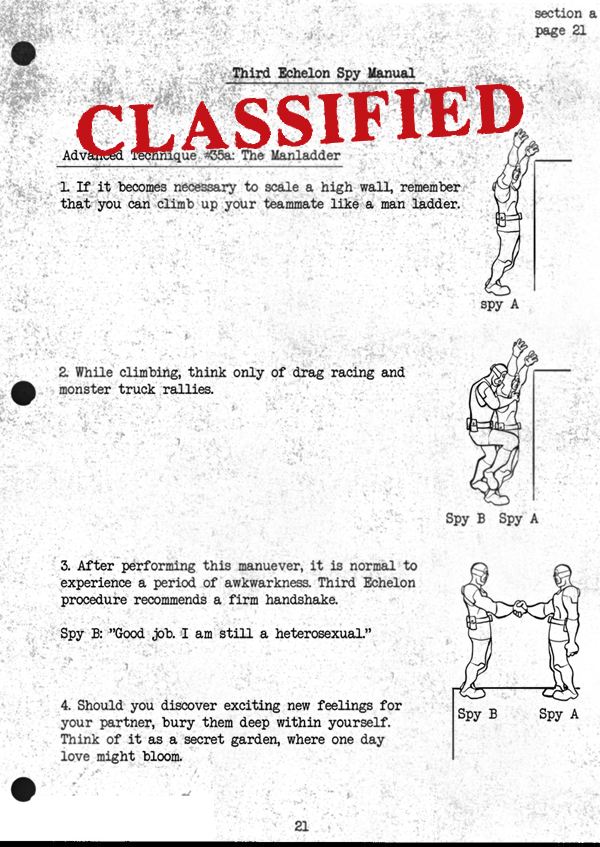

The Crack Team is not the only covert organization in the world, and it would be folly to think we could not learn from others. Agents are encouraged to read this spy manual to learn new techniques.

It’s true, I never was a big Apple fan. I got my kids iPods because they relentlessly kept on asking. Oh, and the players were free when I signed up for a bank account (back in the day).
I inherited the old iPods and am using one today. They are not bad devices: easy to use and pretty to look at. But they are overpriced and I hate having to use iTunes to access my music. I hate being sold new material at every turn. I would love to have a simple drag-and-drop interface.
Sure there were MP3s before the iPod. I don’t blame Steve Jobs for making lossy music palatable. But I don’t share in the global outporing of grief that’s on every TV, computer and iPlatform in the world, either.
And Steve Jobs has a family that’s going thru the grieving process. So why start these tasteless Steve Jobs jokes? We may as well ask why we climb Mt. Everest. It’s because we can.
And you have to admit that it takes talent to make a clever joke about a sad, troubling situation. Sort-of like those improvisation shows where a performer is asked to make a joke about starving Somalians. A very poor-taste request, but also a challenge.
So here’s some jokes about the death of the iconic founder of Apple and the creator of the greatest devices in the world:
 You may remember the story of our hapless Nobel Prize Hero, Doug Prasher. He lost his job in science and ended up driving a courtesy van at a Toyota dealership, but his research allowed others to win the Nobel Prize in 2008. Things are looking up for him, we are glad to report. You can read about it here, starting with this excerpt:
After joining the Toyota dealership, Prasher applied for a couple of science-related jobs in Huntsville, but nothing worked out. On one occasion he had an encouraging meeting with the hiring manager at a local company working on microfluidics; when the interviewer learned that Prasher drove a courtesy van, his interest cooled. There is no way to know how many other potential researchers were driven from their studies for similar reasons, or how many potential discoveries were never made because of the psychological and practical difficulties of the scientific lifestyle.
Finally in June 2010, several weeks after my visit, Prasher’s luck changed. He e-mailed me to say he’d been offered a science job at Streamline Automation, a local research and development company. Staffed by about 20 people, the company does work for NASA, the National Science Foundation, and the U.S. Department of Defense. Prasher’s first task when he started in late June was to help develop technology to sense toxic industrial gases.
He began cautiously. “There was none of the tremendous relief you might expect,” he says. “I had been so discouraged over the years that my attitude was, this may work out and it may not.” Gradually he settled into the job. At home he occasionally took science reading to bed, something he hadn’t done in years. “A lot of the hangdog is gone,” Gina told me. In December Prasher won a six-month, $70,000 grant from the Department of Defense to develop a field technique for categorizing tick specimens according to their mitochondrial genes, in hopes of limiting the diseases a doctor might diagnose. It brought a sense of accomplishment that had been missing from his life for a long time. In January he told me that the cloud of depression he had lived under for years was finally lifting. Science gave him a sense of purpose.