
Variety reports that some democratic politicians (including Hilary Clinton and Joe Biden) are again attacking the game rating entity ESRB over Manhunt 2. The game was originally Adults Only due to violence, but it made some changes and is now Mature. They cite an FTC study that shows 42% of kids under 17 can still buy Rated M games. They’re also saying that you must consider whether the game will be released on the Wii! If it is, they believe it’s actually instructing kids how to kill. Probably doesn’t affect any readers here, but an interesting viewpoint. Like the MPAA, the ESRB was created to avoid gov’t regulation. If they don’t improve enforcement, they’ll fail. Of course, considering how awful the MPAA is, maybe gov’t regulation would be an improvement. And I don’t like big government!
Monthly Archives: December 2007
Darjeeling Limited Review
Natalie Portman naked. Normally those words are used to drive gullible people to fraudulent web sites. In this case, those words will drive you to see The Darjeeling Limited before it leaves theaters.
The film is preceded by Hotel Chevalier, a short film starring Natalie and Jason Schwartzman. It provides a little backstory and context for the main film. It also provides you with an excellent reason to shell out $10.
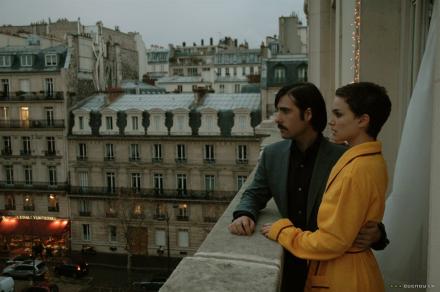
 I could make this review entirely about Natalie’s glorious visage. Forget launching a thousand ships; she could make Farrakhan convert to Judaism1. But anyone who’d find that a worthwhile read is already at Fandango looking up show times.
And it would be unfair to the film, which is worth $10 on its own. For the first two acts, I felt this was Wes Anderson’s best work since Rushmore. Intriguing characters, great humor. Fantastic visual storytelling with beautiful sets. I can easily see this receiving Oscar nominations for art direction and cinematography. And speaking of beauty, Natalie isn’t the only babe in film. We’re introduced to Amara Karan, Sri Lanka’s answer to Rosario Dawson. And there’s even some gorgeous Louis Vuitton luggage (or is it baggage?) that gets its own prominent credit.2
Beyond the visuals there are some great songs on the soundtrack3. Instead of an original score, it comprises songs from other Indian films along with some British invasion classics. In particular, the theme song (Where Do You Go To (My Lovely) by Peter Sarstedt) has been stuck in my head since I left the theater. It tells the tale of a girl from modest means who enters high society in 1960’s Paris. Very Holly Golightly, causing me to draw further parallels between Audrey Hepburn and Natalie Portman. It’s first played during Natalie’s brief appearance, and I’ll probably forever associate it with her. It’s a hauntingly beautiful song, but don’t take my word for it. Have a listen (and pay attention to the lyrics):
My only complaint about the film is that pacing seemed to slow quite a bit during the third act4 . It made the film feel longer than it was, even though the run time is only 91 minutes. I began to expect closing credits at the end of each scene. However, I must give it props for a fitting and highly metaphorical final scene. It just takes a little while to get there.
- It’s lines like this that keep TCT anonymous [↩]
- Unfortunately, I can’t find it for sale anywhere, and it’s not listed on LV’s web site. I know it was custom made, as it was painted by Wes Anderson’s brother. But I was hoping to find a limited run somewhere, even if there’s no chance of affording it before I strike it rich. [↩]
- Available on Rhapsody.com [↩]
- In the film’s defense I was in an uncomfortable seat. [↩]
Maya 2012 and the Exact Date of the Apocalypse
Agent ThinkTank1 recently asked for my opinion about Maya 2012. This is when the Maya Long Count calendar ends, and some people have predicted the end of the world. It is important to note the facts, so I set out to find some. Turns out, facts about Mayan culture are pretty easy to come by. They are also brutally boring. This is because scholars of Maya have completely left out the part about the world ending when the calendar ends. Only the astute new age weirdos have uncovered this. Fortunately for us, the mainstream press regards both equally, and has a very broad definition of scholar.
But Maya civilization lost steam in the 10th century, so as far as they’re concerned, the world ended when the Spanish finally beat them into submission in the late 17th century.
Here is my explanation as a computer scientist. The calendar was invented around 6th century BC. There are two forms, and the first (short count) can handle 52 years. Through The Crack Team’s extensive global network, I have obtained and translated a text that documents the creation of the long count calendar. It is a conversation between Tikal, a royal historian, and Oaxaca, a royal pain computer scientist.
Tikal: Our calendar only covers 52 years, but the king is planning on living longer than that through the magic of human sacrifice. Got any ideas?
Oaxaca: Hmm. How long is he planning on living?
Tikal: Long. He’s planning on sacrificing, like, a shitload of people. I’m guessing at least a couple hundred years.
Oaxaca: Geez. We better plan an escape route after this… But OK, I think I got something. Our society has been around for how long?
Tikal: About 1300 years. It’s hard to say when your calendar only goes to 52 years.
Oaxaca: Right. So the new calendar has to go back that far.
Tikal: Mmm, maybe farther. The king has been thinking about telling people that he’s a couple thousand years old. And that he’s a god. Then everyone will have to say, “Seriously??? You look so young!” And if they don’t say that, he’ll sacrifice them. You might want to remember that.
Oaxaca: OK. Well, I came up with a system that will cover the last 2,500 years, and go 2,500 years into the future.
Tikal: Ooh, he’ll like that. What happens after that?
Oaxaca: I don’t know. It resets, I guess.
Tikal: Huh. Won’t that fuck things up when that happens?
Oaxaca: Who gives a shit? That’s 2,500 years from now! We’re in our 20s, so we got, what? Five more years before we die of old age? I don’t see anybody sacrificing people to keep us alive. It’ll be somebody else’s problem.
Tikal: True dat.
Think about it. 20th century programmers used a date format that would only last to the end of the century, less than 40 years. Who would question 2,500 years?
It’s around this time that you’re thinking, “I thought he was going to tell us the exact date of the apocalypse, instead he’s talking about computer dating.” Don’t worry, I am, and the computer preceding transcript factors in.
Now, some of you read “Maya 2012 apocalypse” and didn’t blink an eye. “According to my calculations,” you thought, “Jesus isn’t Mayan. We’re safe!” And you would be right.
What, you expected an argument from a guy named Archangel?
Before I continue, to borrow a saying from ThinkTank1, what I know about the Bible could fit on the head of a pin and still leave room for the angels to dance. But if you’re as ignorant as me this will sound very plausible, so I’m going to say it.
People worried that Y2K might mark the end of days because it was a significant date – 2,000 years after the birth of Christ (or our best guess) – and because of the looming computer date problem.
But if you’re going pick important dates or anniversaries, the resurrection is far more significant than the birth. Despite what retailers would have you believe, Easter is the holiest holiday, not Christmas. Wouldn’t two millennia after the resurrection be more significant?
Now our best guess for that date is sometime between 2030 and 2040. We don’t know the exact date of the first Easter, but we can search for significant events that will occur in that decade.
This is the point in the movie where everybody is in the library, searching through old texts and manuscripts, microfiche, and the Internet.
Uh, guys? I found one. It’s… it’s big.
January 19, 2038 03:14:07 UTC
It’s known as the Year 2038 Problem. On that day, certain computer clocks will flip and they’ll think it’s 12/13/1901. It affects computer systems that internally represent dates as the number of seconds since (or before) January 1, 1970 (the epoch), and stores that number in a signed 32-bit integer. This is the standard (POSIX) in an incredible number of computer systems, and fixing it is way tricker than fixing the Y2K problem. And the Y2K problem cost us about 300 billion dollars.
We basically have to upgrade everything to use 64-bit operating systems. Many systems are already using 64-bit dates, but that still leaves many millions, including embedded systems that don’t upgrade without a fight. Yeah, we got 30 years to do it, but we had that long for the Y2K problem and we left it to the last minute and freaked everyone out.
I suspect, at best, a repeat performance in 2038. End of the world? You decide.